The script is Greek
The opening letters match the Greek verse epitaph catalogued as RIB 758, not a Latin family genealogy.
Field observation · Greek epigraphy · Frontier identity
Inscription at the Edge
What can a Greek epitaph, an imperial dedication and a reused church wall reveal about life at Verteris?
“The pass narrows movement into necessity. The land decides the route.”
This investigation begins with two convincing wall-mounted impressions photographed inside the church tower. It follows the visible evidence, tests an initial reading and reconstructs the human story that survives.
I · Look
Verteris occupied the western end of the Stainmore Pass, where the principal Roman road across the Pennines connected York with Carlisle. Fort, civilian settlement, cemetery and bathhouse gathered around a corridor imposed as much by geography as by imperial planning.
II · Notice
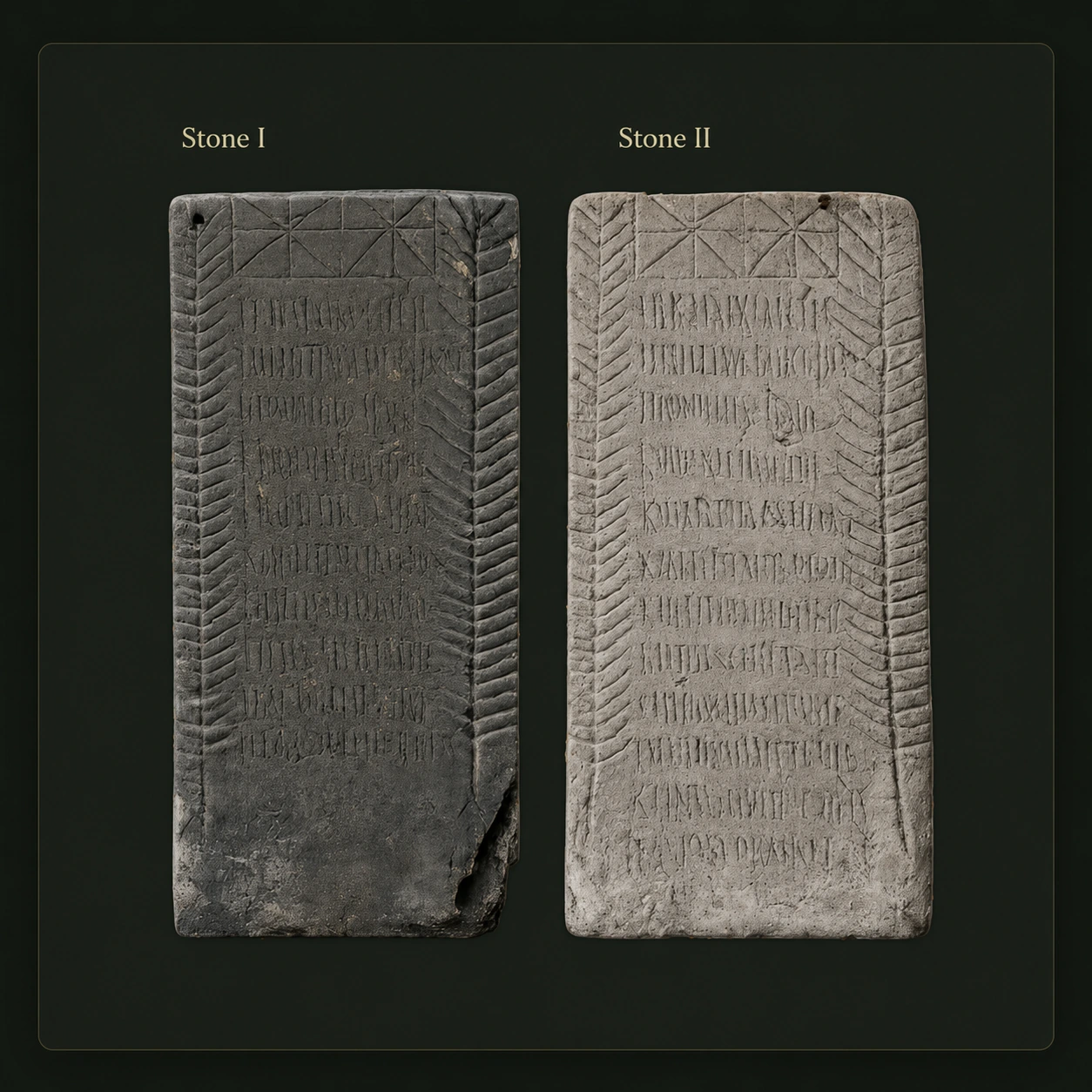
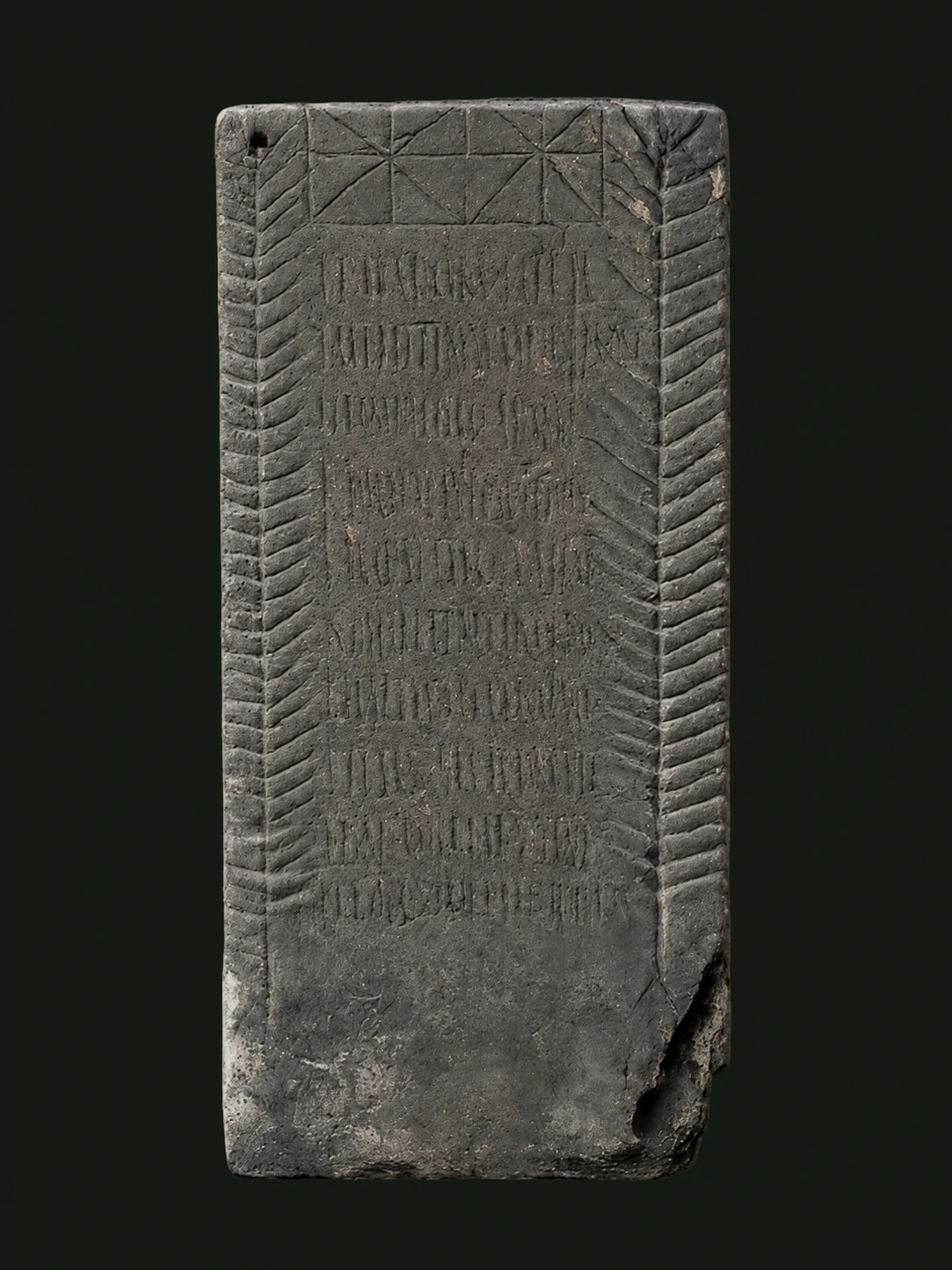
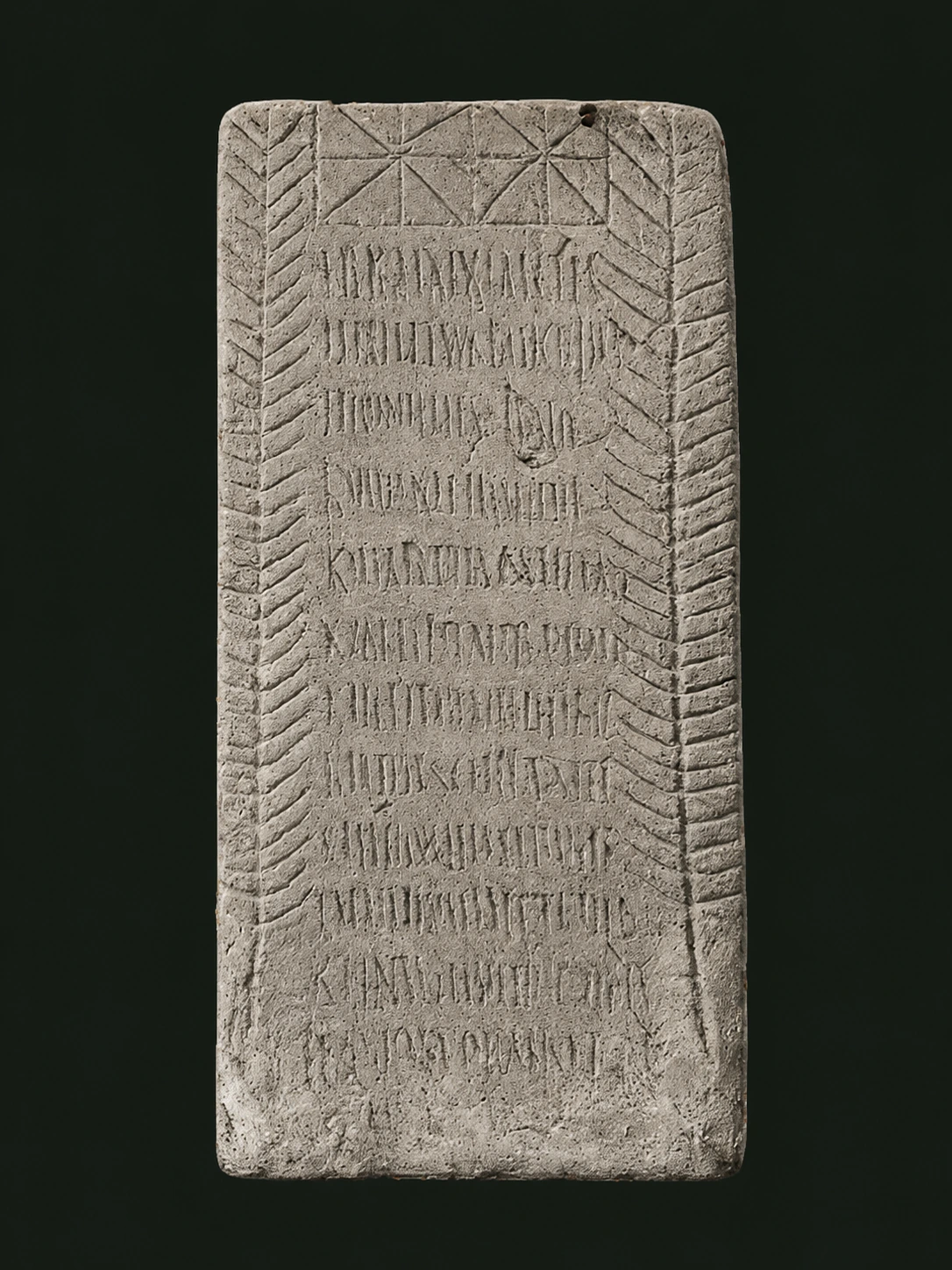
The two wall-mounted objects look convincingly like weathered ancient stone. Yet the official catalogue records the original Greek tombstone in Cambridge and a cast at Brough Church. The photographs therefore open a real investigative question: why are two versions displayed, and what do their differences preserve?
 Stone I
 Stone II
The opening letters match the Greek verse epitaph catalogued as RIB 758, not a Latin family genealogy.
Both versions preserve the same tall text field, triangular head panel and herringbone borders.
The photographs alone cannot establish whether these are stone, plaster or another casting medium.
Evidence hierarchy
First-hand observation tells us what the visitor encountered. The inscription catalogue tells us that the original tombstone is now at the Fitzwilliam Museum and that a cast was placed at Brough Church. The presence of two displayed versions is visible in the photographs but not explained by the sources used here.
III · Reveal
RIB 758 is a third-century Greek verse epitaph. The lettering is not a decorative imitation of Greek culture: it carries a complete memorial poem for a sixteen-year-old from Commagene.
Selected Greek lines
ΕΚΚΑΙΔΕΧΕΤΗ ΤΙΣ
ΙΔΩΝ ΤΥΜΒΩ ΣΚΕΦΘΕΝΤ
ΥΠΟ ΜΟΙΡΗΣ ΕΡΜΗ
ΚΟΜΜΑΓΗΝΟΝ ΕΠΟΣ
ΦΡΑΣΑΤΩ ΤΟΔ ΟΔΕΙΤΗΣ
Greek capital letters · verse epitaph · third century CE
Read the poem in stages
The traveller
The poem addresses the person moving along the road. Seeing the tomb creates an obligation: notice the dead, speak a greeting and carry the memory onward.
The exact wording is fragmentary in places. This page therefore explains the poem’s meaning in modern language rather than presenting a new line-by-line scholarly translation.
IV · Understand
A Greek poem in a Cumbrian frontier settlement names a boy from Commagene in south-eastern Anatolia. It proves connection across the empire. It does not tell us why he travelled, what his legal status was or who paid for the monument.
V · Compare
In 1879, restoration work brought two very different inscriptions to light. One projected imperial authority. The other asked a traveller to remember a dead boy.
RIB 757 · Imperial dedication
Latin capitals · AD 197
The surviving text honours Septimius Severus and Caracalla and dates the dedication by the consulship of Lateranus and Rufinus.
Still built into the church porch.
Open the RIB record →RIB 758 · Funerary verse
Greek capitals · Third century
The poem preserves a name, an age, a distant homeland and the request that a passing stranger perform an act of remembrance.
Original now at the Fitzwilliam Museum; a cast is recorded at Brough Church.
Open the RIB record →One stone names the rulers of the empire. The other names a sixteen-year-old who crossed it.
VI · Follow the object
A Greek verse epitaph commemorates Hermes of Commagene at or near Verteris.
The bottom and left margins were trimmed when the stone was reused as building material.
The tombstone was found during restoration of Brough-under-Stainmore Church.
The Fitzwilliam Museum records the stele as a gift in 1884.
RIB records casts at Brough Church, Tullie House and the Ashmolean Museum.
The object changes without becoming silent
The stone did not remain untouched in an original cemetery. It was cut, reused, found, moved, catalogued and reproduced. Every stage changed its setting. None erased the words completely.
VII · Revise
The first research draft treated the wall display as two Latin genealogical memorials. The photographed lettering, the repeated decorative programme and the official RIB record require a different conclusion.
Initial hypothesis
The proposed reading centred on Anvetenicus, Dionis and Albanus and interpreted three generations of identity.
Evidence check
The visible opening letters correspond to RIB 758, and both panels repeat the Hermes epitaph’s structure.
Revised conclusion
The page now distinguishes what the visit recorded from what the catalogue can establish.
The atmosphere of the visit remains valid. The historical interpretation becomes stronger because the page shows where observation ends, where catalogue evidence begins and where uncertainty honestly remains.
VIII · Return to the place
The wind still crosses the ridge without apology. Sheep graze where soldiers once drilled. The fort is faint beneath pasture. Lorries move where carts once passed, because the land still narrows movement into necessity.
Inside the church, the inscription remains locally present even though the original has travelled again. Hermes had already crossed an empire before his death. His stone crossed from cemetery to wall, from Brough to Cambridge, and back to Brough in reproduced form.
“What endures here is not empire.
What endures is use.”
At the edge of empire, the public language of emperors and the private memory of a boy were preserved by the same later church.
IX · Sources and evidence
The page combines the visitor photographs and field writing with official inscription records, museum cataloguing and protected-site archaeology.
Greek text, date, find context, object history, modern location and recorded casts.
Open RIB 758 → Primary epigraphic catalogueLatin text, AD 197 date, find context and present position in the church porch.
Open RIB 757 → Museum catalogueObject dimensions, sandstone material, acquisition date and current gallery location.
Open the museum record → Protected-site archaeologyOfficial evidence for the fort, civilian settlement, cemetery, bathhouse and Stainmore route.
Open Historic England →Unresolved local detail
The official record confirms a cast at Brough Church but does not explain the two wall-mounted versions visible in the visitor photographs. A church display label, parish archive entry or local guide would be needed to resolve their material and display history.