Imperial power investigation

The Island That
Made Emperors

Rome stationed great armies in Britannia to hold the island. Those armies discovered that they could choose emperors—and repeatedly follow them across the sea.

AD 43–411 Imperial visits Breakaway regimes Army acclamations
Britannia at the centre of imperial movements Gold arrows show emperors travelling into Britain. Red arrows show British-backed claimants moving towards Gaul. York Britannia Gaul Trier / Arles EMPERORS ARRIVE ARMIES DEPART
Imperial visits and recovery Army-backed claims moving outward

Britannia needed a powerful army. That army became political power.

Britain’s distance from the imperial centre and its exposed frontiers demanded a large permanent garrison. The same concentration of trained soldiers gave governors and commanders unusual leverage in Roman succession struggles.

Power moves into Britain

Emperors came to conquer, inspect and recover

Claudius turned invasion into triumph. Hadrian asserted managed frontier control. Septimius Severus brought the imperial court to York. Constantius recovered a province that had sustained its own emperors.
Power moves out of Britain

British-backed claimants carried armies towards Rome

Albinus, Magnus Maximus and Constantine III converted British commands into continental bids for power. Exact troop totals are uncertain, but each movement redirected manpower, money, transport and loyalty.

At first, emperors crossed the sea to secure Britain. Eventually, Britain’s armies crossed the sea to make emperors.

Imperial visits, breakaway regimes and army acclamations

Use the filters to follow a single kind of imperial involvement, or keep the whole sequence visible. Each event changed the political balance within Britain.

Julius Caesar

Pre-imperial expeditions created temporary submissions and client ties.

Claudius

Visited Camulodunum and received surrenders during the conquest.

Hadrian

Visited Britain; the frontier system of Hadrian’s Wall followed.

Clodius Albinus

Moved substantial British-backed forces to Gaul.

Septimius Severus

Held court at York and conducted northern campaigns.

Caracalla and Geta

Shared the expedition and returned after Severus died.

Carausius

Ruled Britain and northern Gaul with independent coinage.

Allectus

Maintained the breakaway state until imperial reconquest.

Constantius I

Recovered Britain, returned north and died at York.

Constantine

Acclaimed Augustus by the army at York; accepted as Caesar.

Magnentius

Rebelled in Gaul; Britain was associated, not the launch point.

Magnus Maximus

Proclaimed in Britain; took forces to Gaul and ruled from Trier.

Marcus

Raised by the army and killed after a short reign.

Gratian

Succeeded Marcus and was killed by dissatisfied troops.

Constantine III

Crossed to Gaul with substantial forces as imperial control unravelled.

Drag or scroll sideways to follow the full chronology.

The garrison becomes a road to continental power

The shield display is conceptual. It shows cumulative military pressure, not a reconstruction of troop numbers, which the surviving evidence does not allow.

Movements from Britain to continental centres of power An interactive diagram traces Albinus to Lugdunum, Magnus Maximus to Trier and Constantine the Third towards Arles. BRITANNIA LUGDUNUM

Conceptual pressure only — each shield is a symbol, not a unit or troop count.

The first great withdrawal

Clodius Albinus: Britannia to Lugdunum

British forces formed a substantial part of Albinus’s army. Their exact number is unknown. His defeat in AD 197 exposed how a heavily garrisoned province could become an imperial power base.

DocumentedAlbinus crossed to Gaul and fought Severus at Lugdunum.
InterpretationThe transfer increased vulnerability, but Britain was not literally emptied of troops.

Albinus · the political warning

The soldiers who guarded Rome’s north-western province became the instrument by which its governor attempted to rule the Roman world.

The later division of Britannia into separate commands is often interpreted as an attempt to prevent any one governor from controlling comparable military resources, although the precise date and motive remain debated.

Breakaway from Rome—or another Rome?

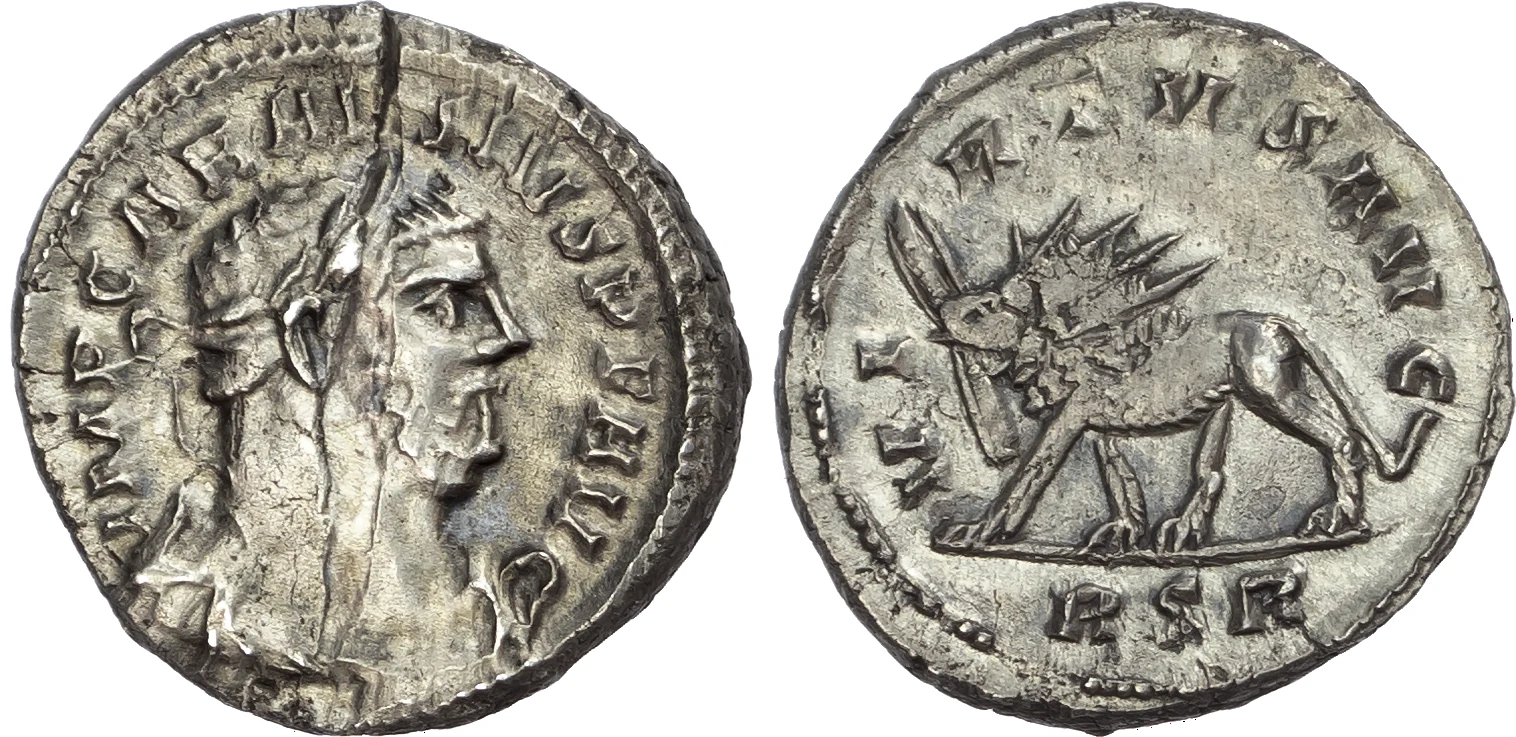
Carausius ruled outside the authority of Diocletian and Maximian, but his coinage did not reject Roman identity. It claimed legitimate Roman government from a different political centre.

Obverse and reverse of a silver denarius of Carausius

Silver denarius of Carausius. Source image: Baldwin’s Auctions.

Read the political message

RSR — “The Golden Age returns”

The reverse mark RSR has been persuasively read as an abbreviation of Redeunt Saturnia Regna. The interpretation is influential rather than beyond dispute, but it places Carausius within an educated Virgilian programme.

The claim

Carausius presented himself as a rightful Roman Augustus and guardian of Britain—not as an anti-Roman king.

What changed

Britain sustained an imperial regime

Carausius secured Britain and territory in northern Gaul. Allectus maintained the breakaway state after Carausius’s assassination in AD 293.

What the coins attempted

Recognition without permission

The plural AVGGG and the formula “Carausius and his brothers” implied fraternity with Diocletian and Maximian. The legitimate emperors never granted it.

What Rome had to do

Mount a major reconquest

Constantius launched a coordinated invasion in AD 296. Asclepiodotus defeated Allectus in a battle whose exact location remains uncertain.

The most consequential imperial event on British soil was an acclamation

When Constantius I died at Eboracum on 25 July AD 306, his soldiers proclaimed Constantine Augustus. Galerius recognised him only as Caesar, but the army’s decision gave Constantine the authority and military base from which his struggle for supremacy began.

York did not merely shelter a claimant. It launched a ruler who would change the structure, capital and religious future of the Roman Empire.

The acclamation

The army at York intervenes in succession

The soldiers proclaimed Constantine Augustus after his father’s death. The decision challenged the intended succession of the Tetrarchy and began a long contest for supremacy.

Magnus Maximus and the dream of Macsen Wledig

The historical commander and the remembered Macsen stand almost in inversion: one draws power from Britain; the other becomes a source of British legitimacy.

AD 383–388

Emperor and army on the move

Proclaimed in Britain, Maximus crossed to Gaul, defeated Gratian and established a court at Trier. He was defeated and executed by Theodosius I after attempting to extend his rule into Italy.

The force he removed cannot be reconstructed with confidence. The safest conclusion is cumulative: his regime redirected soldiers, officers and administrative energy and added to longer military and fiscal strain.

A man remembered in some historical traditions for carrying military strength away from Britain was reimagined as an emperor who bestowed authority upon it.

The army tests, replaces and finally follows its candidates

The evidence for AD 406–407 is thin and often hostile or retrospective. What survives is a rapid sequence of acclamations during the wider breakdown of western imperial control.

The first choice

Marcus is elevated and killed after a short reign

The surviving account gives little detail. His rapid removal shows that military acclamation did not guarantee loyalty or durability.

What did not happen

Roman Britain did not end on a single day

Not every soldier departed in AD 407. Garrison elements, local officials and Romano-British communities remained, and the chronology of the final break is debated.

What changed decisively

Central government lost the capacity to command and reinforce

By AD 409–410, communities in Britain had expelled Constantine’s officials and were organising their own defence. No later emperor restored durable central rule.

Britain was not simply lost; it was repeatedly spent as currency in continental civil wars.

Usurpation was not the sole cause of Roman Britain’s ending. Civil conflict combined with external attack, weakening taxation, declining long-distance supply, contested authority and local change. Yet the usurpers revealed the province’s most dangerous contradiction.

Civil conflictFrontier pressureFiscal strainSupply declineContested authorityLocal response

The garrison that protected Britain could also decide that the road to power lay across the Channel.

Presence, proclamation, interpretation and memory are not the same thing

The investigation keeps categories separate because ancient accounts are uneven, political and often hostile to defeated claimants.

Documented connection

Literary or material evidence places the individual in Britain, or records a proclamation or regime based there.

Historical interpretation

Troop withdrawals and their cumulative effects are strongly significant, but exact numbers and single-cause claims cannot be sustained.

Later cultural memory

The Macsen tradition reveals how post-Roman societies reshaped a usurper into a source of sovereignty and descent.

Roman Storyworld Research Archive

Read the complete study

The companion paper contains the integrated chronology, evidence cautions and full primary and scholarly bibliography used to build this investigation.

Open the research paper
View selected sources and further reading

Ancient sources: Julius Caesar, Cassius Dio, Suetonius, Herodian, Lactantius, Eusebius, Zosimus and Gildas.

Modern studies: P. Salway, A. R. Birley, P. J. Casey, T. D. Barnes, A. S. Esmonde Cleary, J. F. Drinkwater, M. Kulikowski and G. de la Bédoyère.

Material evidence: British Museum coin records for Carausius; English Heritage interpretation of Roman Britain, Hadrian and Septimius Severus.

British Museum: Carausius collection records ↗ English Heritage: the Romans ↗