Claim
Do two diplomas reveal a distinctive military landscape in Cheshire?
Evidence-Led Investigation · Cheshire · AD 103–105
Two military diplomas, salt and settlement in Cornovian Cheshire.
Why did two long-serving auxiliary cavalrymen leave their bronze citizenship documents in the same small region of Britain, little more than two years apart?
The investigation
In 1812, two bronze tablets were found in a field on Barhill Farm at Bickley, about two miles east-south-east of Malpas. They proved to be the personal copy of an imperial military diploma issued on 19 January AD 103 to Reburrus, son of Severus, a Spaniard and decurion of ala I Pannoniorum Tampiana. The bronze gives us a named man, a precise date, a rank and a unit — and an unexpected Cheshire findspot.
Then, only about 28–30 months later, another diploma appears at Middlewich, recording a cavalryman of ala Classiana and his wife Amabilis. Its findspot lies not in Harbutt's Field fort, but farther south beside King Street in the Roman industrial settlement — a landscape where archaeology has revealed salt working.
Do two diplomas reveal a distinctive military landscape in Cheshire?
Read what the AD 103 and AD 105 bronzes actually grant — and what they do not.
Put Bickley beside Middlewich, its fort, roads, workshops and salt-working evidence.
Veterans, serving soldiers, family ties, trade, land — or documents that moved later.
Separate the striking coincidence from claims the evidence cannot yet carry.
Two pieces of bronze open a larger question: who was becoming at home in Roman Cheshire?
Claim
The Bickley diploma was found in 1812 on Barhill Farm near Malpas. It is dated precisely to 19 January AD 103 and names Reburrus, son of Severus, a Spaniard and decurion of ala I Pannoniorum Tampiana.[1]
The Middlewich diploma was found in 1939 during housebuilding on the west side of King Street, together with samian and Roman coarse pottery. It dates to 4 May–13 July AD 105 and names, fragmentarily, a cavalryman of ala Classiana civium Romanorum and his wife Amabilis, daughter of Firmus.[2]
Why do two early Trajanic auxiliary diplomas, issued only about two and a half years apart, enter the archaeological record of Cheshire?
Ancient evidence
The RIB corpus places the surviving British diploma sequence between AD 98 and about AD 161. The Bickley and Middlewich pieces therefore sit very early in that surviving sequence.[3]
The AD 103 formula says the beneficiaries were soldiers serving in the named units who had completed twenty-five or more years. RIB explicitly notes that Reburrus was still serving.[1] The Middlewich text uses the same serving-soldier logic, although its damaged formula leaves some technical uncertainty over the precise diploma type.[2]
So we cannot write a biography in which each man received a diploma, retired that day, and was handed a Cheshire farm.
Twenty-five years counted backwards places Reburrus in service by AD 78 at the latest, and the Middlewich cavalryman by about AD 80 at the latest. That overlaps the Agricolan campaigning generation. It is a career envelope, not proof that either man fought in a particular battle.
Latest likely entry into service if each had completed the minimum twenty-five years by the diploma date.
Calculated contextThe surviving RIB sequence for British auxiliary diplomas begins in this period.
Corpus contextReburrus is named as a serving decurion in Britain.
DocumentedThe Middlewich cavalryman and Amabilis appear in another British diploma issue.
DocumentedArchaeology
Reburrus's two tablets were recovered from a field belonging to Barhill Farm. No villa, veteran colony or property belonging to Reburrus has been identified there.[1]
The old question remains legitimate: did the diploma stay with Reburrus or his household because he lived in this countryside? The findspot alone cannot answer it.
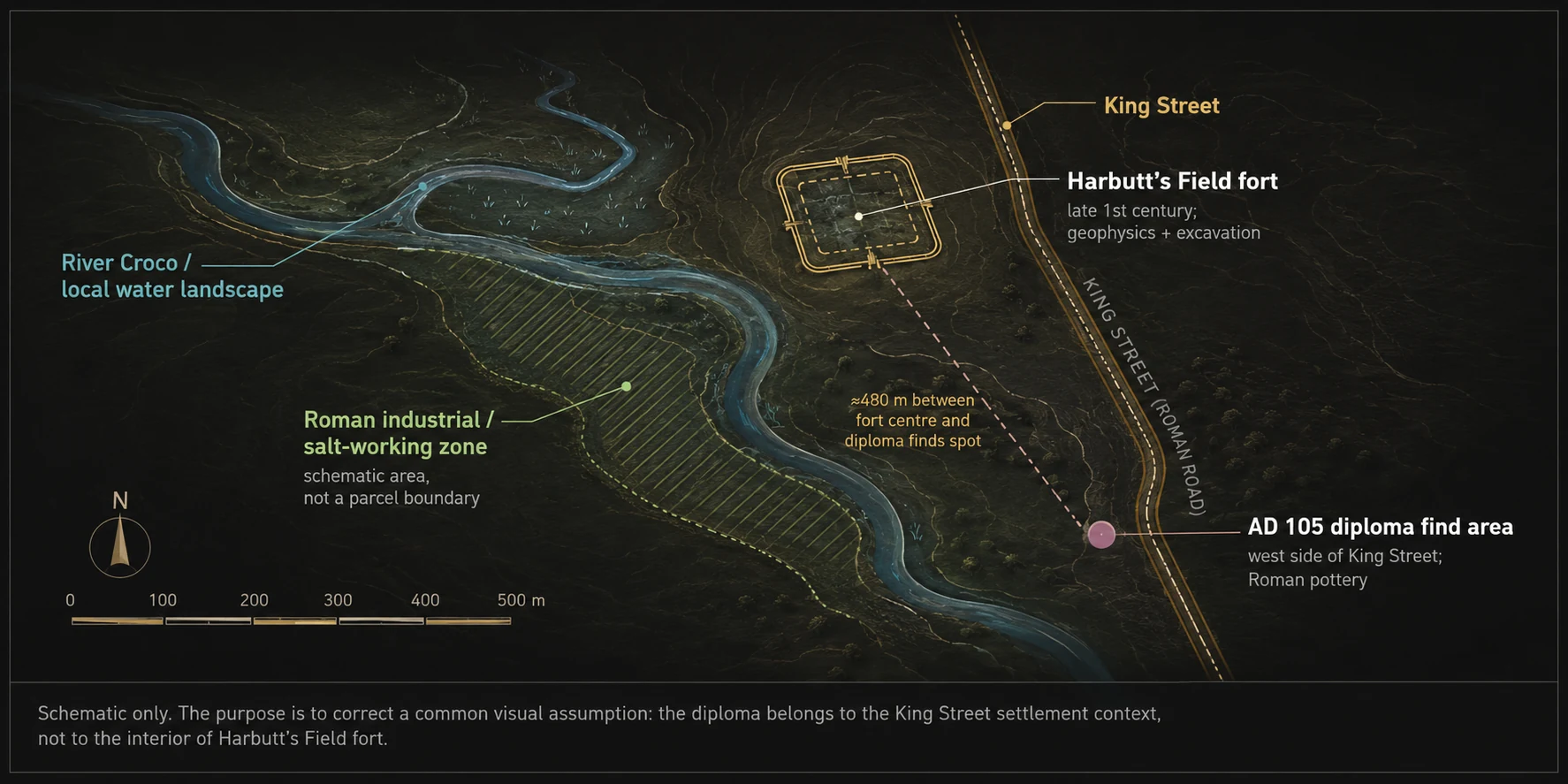
The diploma was not found in Harbutt's Field fort. Its recorded grid reference lies about 480 metres south-south-east of the fort, on the west side of King Street, with Roman pottery.[2][9]
Archaeology along this King Street corridor has revealed timber buildings, workshops and salt-working evidence, including a brine kiln excavated by Harding and Blake and later salt-industry remains.[8][10]
Cheshire's brine was not a Roman discovery. Archaeological research collected in Brine in Britannia places Middlewich within a longer Iron Age and Romano-British inland salt tradition. Roman occupation intensified and reorganised production rather than creating the resource from nothing.[7]
At Jersey Way, large-scale excavation recovered waterlogged Roman timber structures associated with salt production, including a brine well, together with settlement and agricultural evidence.[8] This makes Middlewich more than a fort with an accidental industry beside it: it was a settlement embedded in a valuable resource landscape.
Land and power
At the broad regional scale, the answer is probably yes — but the edges are blurred. Ptolemy names Deva as a polis of the Cornovii, while modern settlement synthesis warns that the true extent of Cornovian territory is unknown.[6]
Roman conquest then created a new legal geography. Mason's study of the prata legionis shows that a legionary fortress could control a substantial territory around itself, functioning as military land beside civilian or civitas territory.[5] Chester therefore raises a real question about the transfer of indigenous landscapes into direct military control.
Did Rome merely control this landscape, or did soldiers and former soldiers begin to acquire lasting stakes in land, trade and local communities that had once belonged wholly to indigenous systems?
Competing interpretations
Veteran-settlement studies make one broad tendency worth testing: soldiers could remain near the provinces and stations where long service had rooted them, rather than automatically returning to distant birthplaces. Mann discusses this tendency for veterans in Britain, while Roxan's study warns that diploma findspots are a biased sample shaped by preservation, ownership and movement.[4][11]
Twenty-five years creates relationships, knowledge and opportunity. Comparative work on veteran settlement makes staying in or near a service province historically credible.
Road traffic, salt, workshops and military demand created opportunities in transport, craft, property and supply. The diploma does not identify the recipient's occupation outside cavalry service.
Amabilis is named on the Middlewich diploma, but her place of origin is lost. We cannot label her British or Cornovian from her Latin name.
A personal diploma in rural ground keeps the hypothesis alive. There is still no identified building, estate or legal grant connecting him to Barhill.
Military territories and post-conquest transfers of control are real phenomena; this specific chain of ownership has not been recovered.
Two unusual findspots form a research problem, not a colonia. No charter, planned veteran allotment or settlement inscription supports that conclusion.
Evidence audit
Yes — AD 103 and AD 105, roughly 28–30 months apart.
Yes — Reburrus was a decurion; the Middlewich recipient was a cavalryman.
Yes — the constitutions concern men with twenty-five or more years of service.
Yes — excavated brine-processing features and industrial evidence are secure.
Yes — geophysics and excavation reveal a late first-century auxiliary fort.
Plausible, but findspot is not the same thing as residence.
Unknown. Her name and patronymic do not establish origin.
No. The diplomas grant citizenship and marriage rights, not named estates.
What survives
Reburrus came from Hispania. The Middlewich cavalryman's name and birthplace are damaged, but his wife Amabilis survives in the bronze. Both men had spent at least a quarter-century inside the Roman military system before their documents were issued.
The place where those documents eventually entered the soil matters. One appears in rural Bickley. The other appears in a busy road-and-industry settlement exploiting a resource that long pre-dated Rome.
The diplomas do not prove that Rome gave Cornovian land to veterans. They reveal something subtler: conquest created a landscape in which men who arrived as outsiders could acquire citizenship, relationships, economic opportunities — and perhaps reasons not to leave.
That is the deeper question behind the two pieces of bronze. After twenty-five years, where was home?Sources
Primary epigraphic record for the Bickley/Malpas diploma: date, recipient, unit, serving status and find context.
Primary epigraphic record for the fragmentary Middlewich diploma, including Amabilis and the King Street find context.
Overview of the British military diploma corpus and its surviving chronological range.
Important comparative discussion of where auxiliary veterans settled after service in Britain.
Key study of legionary territories and direct military control of land around British legionary fortresses.
Regional synthesis for the Cornovian landscape, Chester, Wroxeter and the differing organisation of their hinterlands.
Major collection on Iron Age and Romano-British salt production in Cheshire, including Middlewich and the organisation of the industry.
Large-scale excavation of Roman salt-working infrastructure, including waterlogged timbers and a brine well.
Scheduled monument record summarising the geophysical and excavated evidence for the late first-century fort.
Summarises King Street settlement archaeology, Harding and Blake's brine kiln, timber buildings and later industrial evidence.
Foundational study of what diploma findspots can — and cannot — tell us about mobility, ownership and veteran settlement.